

Laryngectomy kit guidance
In this section you will find images and descriptions of the equipment used by a laryngectomy patient. These items may vary depending on the brand/design of the item so the images used below may not exactly match your own.
How you order supplies will vary depending on the area you live in and the team you are under. Always talk to your team about your own kit.
You will also find a quick A-Z guide of terms and acronyms at the bottom of this page.
If you would like to discuss specific equipment or find out about other members' lived experiences with different kits, please join our Facebook Community. It is a safe space to ask questions, share tips, and see what works best for others in their daily lives.
Baseplate
This is adhesive and sticks over the opening in the neck (stoma). This must be changed multiple times a week and can come off due to coughing/weather changes/showering. These vary in shape so you can find one that fits your individual stoma. There are also variations for different settings i.e. extra stability, sensitive skin, night time etc.
You can see listings for baseplates on the Atos & Blom-Singer websites. The time a baseplate will last can depend on a variety of factors including how well it was applied, the shape of your neck, the weather or activity you are doing etc. Once the baseplate adhesive begins to wear you will need to replace it. The brand you use may depend on what your team recommend or what works best for you. See this guide from NHS University Hospitals Coventry & Warwickshire on how to apply a baseplate.

Heat moisture exchange (HME)
Heat & Moisture exchange (HME). These act as filters and replace the function of the nose by allowing cold air to moisten and heat up as it enters the stoma. They slot into the hole in the baseplate and also prevent dust etc from entering the stoma. They also provide resistance so that the air is not too easy to breathe in, to maintain lung health and strength. This is also how those with a TEP valve are able to speak. By pressing the button
airflow is stopped and forced back and up out the mouth. These have to be changed every day potentially multiple times daily. They come in a variety of forms. Including lower resistance for exercise, the layer of foam is less dense allowing for more air to flow through. Extra protection, these HMEs offer a higher level of protection against viruses, dust and pollen. If you need to cough or sneeze you need to remove the HME to do so, as you will likely have less control over these functions it is advisable to carry extras when out and about.
Read more about how an HME works on Atos website.

Hands-Free HME
A regular HME requires you to press a finger to the button to be able to speak. There are hands free devices available however your ability to use these will depend on your lung and voice strength. Some of the hands free HMEs can be manually adjusted to account for your own needs whereas others you might need to try out the different options. Your speech and language therapist will be able to talk to you about your suitability for hands free as well as go over the options.

Lary tube
A Lary tube (laryngectomy tube) is a soft, flexible silicone device inserted into the neck stoma after a laryngectomy to keep the permanent airway opening from closing, shrinking, or getting irritated. These come in a variety of styles and lengths, you need to remove the tube to clean it. An HME can often be inserted into the top. This tube is held in place with a band that is secured around the circumference of the neck or lary clips which are adhesive pads that stick to each side of the stoma.

Lary button
Similar to the lary tube the lary button is inserted inside the stoma. As it does not have the long tube section it may be more tolerable to use for some people. It will also help to maintain stoma size and shape.

Foam stoma cover
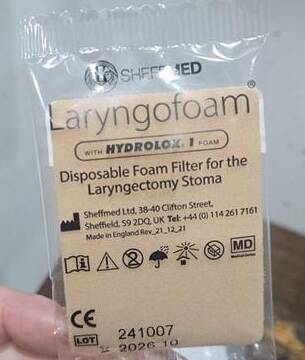
These are simple foam patches that cover the stoma in. If you do not wear an HME or lary tube these provide light coverage for the stoma. They do not provide as much resistance for the lungs but do not require a baseplate as they have a small adhesive strip that attaches to the skin above the stoma.
TEP
Tracheo-Oesophageal Puncture (TEP) which is sometimes created during or after surgery. This can be seen in the diagram image. This is a hole that is made between the wind pipe and food pipe (oesophagus) where a silicone valve is placed to allow for voicing. The valve has a small flap at the back which remains closed so that when you eat and drink no liquid comes through into the trachea. To speak you press the HME or otherwise occlude the stoma and air forces the valve open and allows speech. These valves are not permanent and have a lifespan of anywhere between a few weeks to a year. If the valve starts to fail then liquid leaks through into the trachea and causes coughing. Generally a speech and language therapist (SLT) is required to change this however there are options to self-change your own valve, this is dependent on your own situation so please speak with your team. During the time the valve is leaking, drinking can be difficult although drinking at the same time as swallowing food can prevent leaking. You can also use liquid thickeners to help during this time. Not all patients are suitable for a TEP. You can read more about TEPs here.

Skin barrier wipes
These wipes are used when changing your baseplate. They help to remove the adhesive and prepare the skin for a new baseplate to be applied.

TEP cleaning brush & pipette
The TEP valve needs to be cleaned multiple times a day to prevent food from getting stuck and holding the flap open which would then let liquids leak out. Stuck food can also prevent you from being able to speak. It is important to cary this everywhere with you. The small brush designed specifically for the valve you have so you should use the one given to you by your speech and language therapist. The other item pictured is a pipette to squirt water into the valve to clear it.

Shower guard
As you cannot get water in your stoma you need to wear a shower guard when showering. This is essentially a downward facing funnel that allows the water to pass over allowing you to breathe safely. These slot into the baseplate (as pictured). If you do not wear a baseplate then you will need to wear a waterproof bib.

Nebuliser
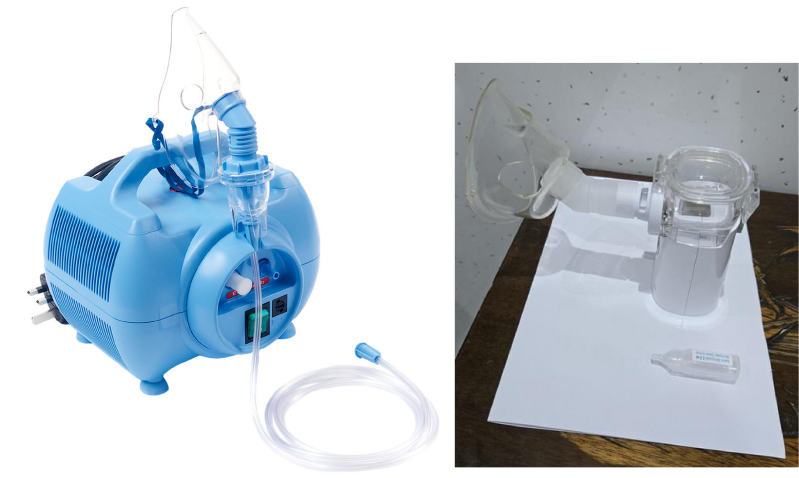
People who have had a laryngectomy are recommended to use a nebuliser. Some people find they need to nebulise quite often and others not at all. This device dispenses saline in a fine mist which is held over the stoma and breathed in to moisten the airway and loosen/thin mucus. You may be sent home from hospital with a large mains powered nebuliser similar to the blue one pictured.You can buy your own portable nebuliser which is a smaller handheld device that is battery operated and silent. Both forms of nebuliser use saline, this is usually provided in small ampules.
Never use normal water in a nebuliser, always use what you are instructed to by your team. It is also important not to use glass ampules as opening these can cause tiny shards of glass to be in the solution.
TEP plug
If the TEP valve leaks you should have a plug you can use as a back-up. This sticks into the front of the valve preventing any liquids coming out. The silicone plug must then be taped up on the neck until he can be seen by a SLT. While using the plug you will not be able to speak with your TEP. Pictured is the clear silicone plug and the white plastic inserter tool.
You can read instructions on using the plug here.

Quick A-Z guide
Here you will find explanations for commonly used terms and acronyms